Sunday, April 28, 2013

Mroski Frankenweenie


In 1984, Tim Burton proposed a short film to Disney to be played before Pinocchio.  The film, called Frankenweenie, followed a boy named Victor Frankenstein, who resurrected his dog after it was hit by a car.  After it was completed, the studio rejected the film, asserting that the film was “too dark.”  Years later, the film has been remade, this time as a full length, stop-motion Disney feature film.
Frankenweenie, though it has been changed in many ways, still retains its core elements and plot line.  Also, many of the same exact shots have been replicated into the new film, while characters and events have been added.  The movie’s entire method of filming has been changed from live action to stop motion, with both positive and negative results.
Most of the plot line has stayed the same; the dog gets hit by a car, Victor revives him, the townspeople revolt against the dog, the dog dies, and then they jump him back to life with their cars.  The film shows striking resemblance to its 1984 counterpart; whole scenes have been cloned, such as the resurrection and grave digging scenes.  Other aspects also stayed the same, like the black and white production.  Otherwise, though, many ideas have been added to the film.  New characters from his school have been added, all with wildly odd personalities and features.  A branch has been added to the plotline, as all of these other students attempt and fail to resurrect other animals, with mutant results.  Though all of these aspects were funny, they made us take breaks from the solid, engaging plotline from the 1984 film.  The shorter format allows for a stronger story that moves at a quicker and more emotional pace. 
Though I find that I did not like the stop motion as much as the live action format, the stop motion does have some advantages.  The characters from Victor’s school are a perfect example of the high degree of characterization that can accomplished through this new medium.  Mr. Rzykruski was especially drawn out. His ridiculously long face and thick accent drew constant laughter throughout the audience, along with the other members of the classroom.  The best advantage to stop motion is the ability to further characterize animals.  Sparky is a far better stop-motion character than live action.  Real dogs don’t pay attention to whatever it is that they are trying to “act” out, but animated ones actually do show obvious emotional change and appropriate responses to situations.  Humans, however, are better filmed live.  Victor as a live action child was a far more moving performance than in the new film.  Everyone in a cartoon somewhat looks like a child, so I always forget that Victor is a kid in the newer film, whereas it is obvious that Victor is 10 years old throughout the 1984 film.  Also, seeing  Shelley Duvall in the older film was enough to make me pick the older one, since she is such a great actress.

Friday, April 19, 2013

Mroski Sweeney Todd


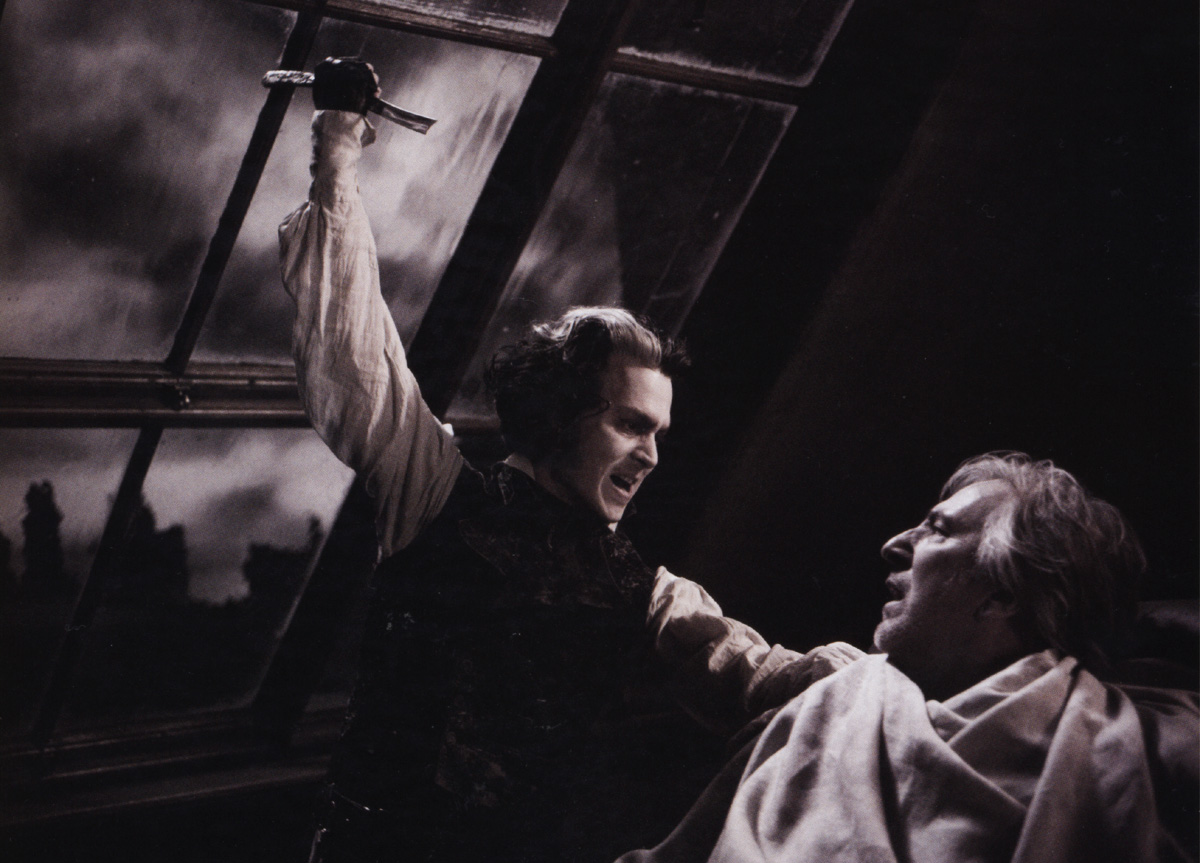
Tim Burton’s adaption of Sweeney Todd, though full of cannibalistic murder and corruption, is a strangely happy movie.  While I was watching the film, I actually forgot that the acts that Todd and Lovett were immoral. I was too wrapped up into the music and the characters.
                Firstly, the score was incredible.  The songs are often cheerful and bouncy, unlike the twisted plot that goes with it.  This creates a clash between happy and gloomy that helps us begin to dissolve our conceptions of good and bad.  Their crimes seem almost innocent due to the joy that goes into the act, the prosperity that they gain, and the inclusion of a young kid as a waiter.
                Furthermore, the issue of revenge is strong with us.  We can empathize with Mr. Todd because of the absolutely horrendous crimes that have been done to him.  By the time he goes AWOL we are already so invested in his bloodshed that we are still rooting for him.  His revenge is taken in his murders, even if those murders are unjust, and we must see him take that revenge.
Another reason that the film gets around the question of morality is by simply not mentioning it.  Most movies with so much murder have characters with an internal struggle.  Often, the murderers are either full of guilt, or at least do not like what they do.  In Sweeny Todd, Sweeny only talks of the positives of killing, singing that we “all deserve to die.”  Mrs. Lovett especially takes up the deed with leisure.  She doesn’t say anything but that it is a “downright shame” to waste Mr. Perelli’s body. Both of these characters’ detachment leads us to believe that this is the only option, totally reasonable, given their circumstances in “desperate times”

Friday, April 12, 2013

Mroski Big Fish


Edward has qualities of both an insider and an outsider.  He looks normal, he isn’t disfigured mentally, he lives in the suburbs and he’s fine with it, etc.  His outsider quality is his sense of adventure that makes him leave places very easily, as well as his overwhelming optimism and his disregard for dangerous situations. 
Carl the Giant likes Edward Bloom because they are both, in their own ways, larger than life.  Edward is an adventurer.  He is a big fish in a little pond.  Carl is a Giant man in a little Town.  That said, they have lots in common.  Both of them, however, do have something to offer the other.  Edward needs a reason to leave, and Carl is the exact type of person he should be on an adventure with—a giant.  Edward likes Carl because since he was a child, he has understood how some people are too big for one place.  In a way, Edward sees himself in Carl’s giant shoes and sympathizes.   Carl enjoys being with Edward, because he is one of the only people who treat him like a normal person.  Burton’s outsiders, like Carl, crave a sense of normalcy.  That’s why when Edward brings him to the circus, he is so at home.  At the circus, he is normal.  So, they both had to take each other out of that town at the same time.  They bring each other on this journey where they get what they want—Edward, an adventure; and Carl, a home.
The Siamese twins also have a similar connection with Edward Bloom.  The first time we see them singing, they are singing about love.  Though it seems like it’s just a sensual little song, we find later that there is some truth behind it.  They connect so strongly with Edward’s story about his wife that they take a journey all around with him, looking for the affection that they eventually find in Norther Winslow.  They like each other because they share an appreciation for love.

Friday, April 5, 2013

Mroski Sleepy Hollow


Shortly after starting Sleepy Hollow, we can see that Washington Irving's story has been altered significantly. The “dreamy” wives’ tale that Irving created has been twisted into a dark, gory horror film that feels completely different and yet still very familiar to the short story. 
One way that Tim Burton changes the story is in the movie’s atmosphere.  In the short story, Sleepy Hollow is a prosperous, beautiful place full of food and happy people.  The residents in Irving’s story aren’t in a state of constant fear, but are generally very marry.  The only place that the townspeople are fearful is the forest, and of course, the Hollow.  This overall tranquility is good because it gives the story a fairy-tale feeling that helps make the legend associated with the hollow more ambiguous, much like the tales that the women tell.
Tim Burton changes the hollow into a dreary gray world, always dark, and shrouded in fog.  This grave atmospheric change creates a feeling of dread throughout the movie.  Everyone seems suspicious.  The buildings are falling apart.  Even before anything is said, we can tell that the town isn’t very safe.  Burton uses this alteration to his advantage because it makes the horseman more believable than if Tarry Town were dreamy and peaceful.  One piece of common ground is the fact that the forest is seriously dangerous here.  Both stories share a wariness of the forest and what lurks inside.
In both the story and the movie, Crane carries many similarities.  They both share high levels of education, making them smarter than the townsfolk.  They are both awkward; Irving’s Ichabod is a gangly glutton, and Burton’s is jittery and unsettled.  Burton digresses at one truly major point—their pasts.  The short story doesn’t give much detail to Ichabod’s past, but Burton gives his Ichabod one hell of a history to deal with.  The his father’s cold-blooded murder of his mother shapes him as a person.  He has to deal with this for the rest of his life.  This is mostly seen in an inner clash between his scientific and supernatural beliefs.  I think Burton did this in order to create a depth in the character.  It is just more exciting.  This dark past also compliments the dark world that he is trying to create.  Plus, what is a Burton story without a mentally disfigured orphan man.