Sunday, April 28, 2013

Mroski Frankenweenie


In 1984, Tim Burton proposed a short film to Disney to be played before Pinocchio.  The film, called Frankenweenie, followed a boy named Victor Frankenstein, who resurrected his dog after it was hit by a car.  After it was completed, the studio rejected the film, asserting that the film was “too dark.”  Years later, the film has been remade, this time as a full length, stop-motion Disney feature film.
Frankenweenie, though it has been changed in many ways, still retains its core elements and plot line.  Also, many of the same exact shots have been replicated into the new film, while characters and events have been added.  The movie’s entire method of filming has been changed from live action to stop motion, with both positive and negative results.
Most of the plot line has stayed the same; the dog gets hit by a car, Victor revives him, the townspeople revolt against the dog, the dog dies, and then they jump him back to life with their cars.  The film shows striking resemblance to its 1984 counterpart; whole scenes have been cloned, such as the resurrection and grave digging scenes.  Other aspects also stayed the same, like the black and white production.  Otherwise, though, many ideas have been added to the film.  New characters from his school have been added, all with wildly odd personalities and features.  A branch has been added to the plotline, as all of these other students attempt and fail to resurrect other animals, with mutant results.  Though all of these aspects were funny, they made us take breaks from the solid, engaging plotline from the 1984 film.  The shorter format allows for a stronger story that moves at a quicker and more emotional pace. 
Though I find that I did not like the stop motion as much as the live action format, the stop motion does have some advantages.  The characters from Victor’s school are a perfect example of the high degree of characterization that can accomplished through this new medium.  Mr. Rzykruski was especially drawn out. His ridiculously long face and thick accent drew constant laughter throughout the audience, along with the other members of the classroom.  The best advantage to stop motion is the ability to further characterize animals.  Sparky is a far better stop-motion character than live action.  Real dogs don’t pay attention to whatever it is that they are trying to “act” out, but animated ones actually do show obvious emotional change and appropriate responses to situations.  Humans, however, are better filmed live.  Victor as a live action child was a far more moving performance than in the new film.  Everyone in a cartoon somewhat looks like a child, so I always forget that Victor is a kid in the newer film, whereas it is obvious that Victor is 10 years old throughout the 1984 film.  Also, seeing  Shelley Duvall in the older film was enough to make me pick the older one, since she is such a great actress.

Friday, April 19, 2013

Mroski Sweeney Todd


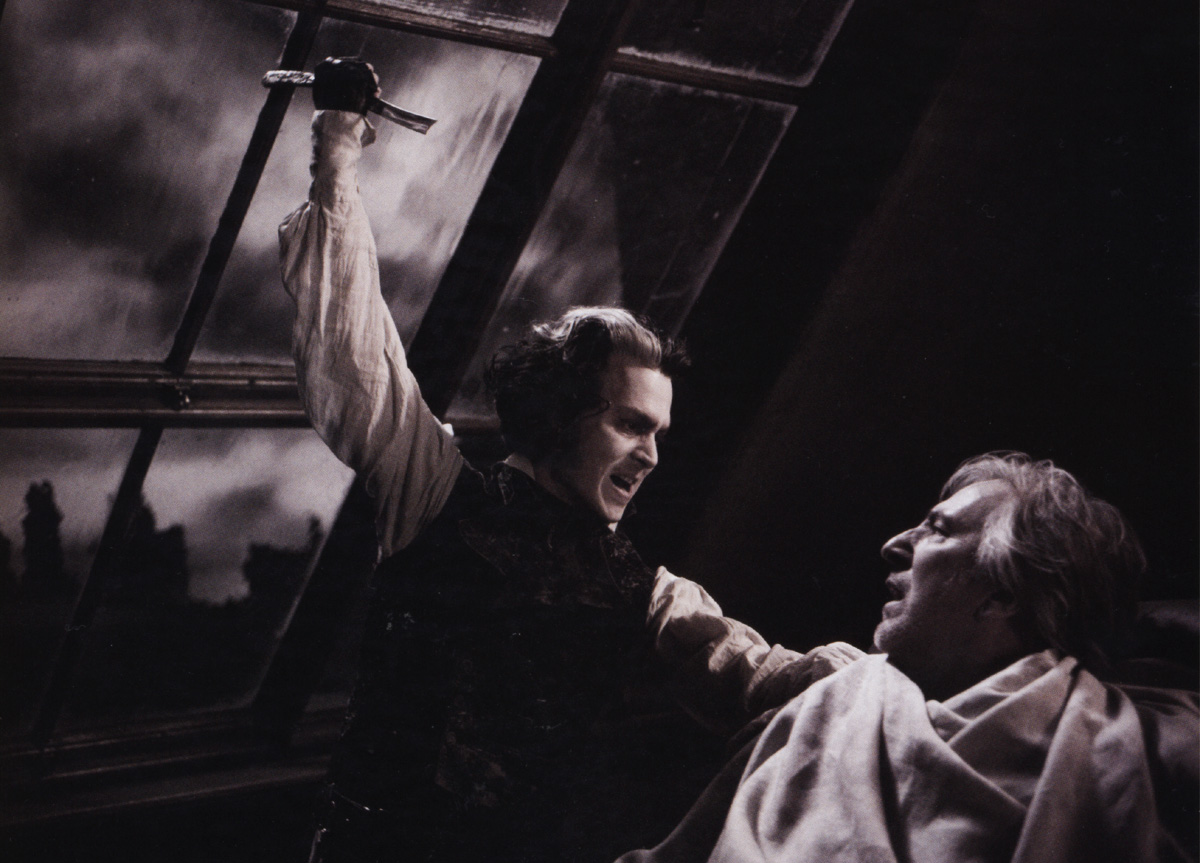
Tim Burton’s adaption of Sweeney Todd, though full of cannibalistic murder and corruption, is a strangely happy movie.  While I was watching the film, I actually forgot that the acts that Todd and Lovett were immoral. I was too wrapped up into the music and the characters.
                Firstly, the score was incredible.  The songs are often cheerful and bouncy, unlike the twisted plot that goes with it.  This creates a clash between happy and gloomy that helps us begin to dissolve our conceptions of good and bad.  Their crimes seem almost innocent due to the joy that goes into the act, the prosperity that they gain, and the inclusion of a young kid as a waiter.
                Furthermore, the issue of revenge is strong with us.  We can empathize with Mr. Todd because of the absolutely horrendous crimes that have been done to him.  By the time he goes AWOL we are already so invested in his bloodshed that we are still rooting for him.  His revenge is taken in his murders, even if those murders are unjust, and we must see him take that revenge.
Another reason that the film gets around the question of morality is by simply not mentioning it.  Most movies with so much murder have characters with an internal struggle.  Often, the murderers are either full of guilt, or at least do not like what they do.  In Sweeny Todd, Sweeny only talks of the positives of killing, singing that we “all deserve to die.”  Mrs. Lovett especially takes up the deed with leisure.  She doesn’t say anything but that it is a “downright shame” to waste Mr. Perelli’s body. Both of these characters’ detachment leads us to believe that this is the only option, totally reasonable, given their circumstances in “desperate times”

Friday, April 12, 2013

Mroski Big Fish


Edward has qualities of both an insider and an outsider.  He looks normal, he isn’t disfigured mentally, he lives in the suburbs and he’s fine with it, etc.  His outsider quality is his sense of adventure that makes him leave places very easily, as well as his overwhelming optimism and his disregard for dangerous situations. 
Carl the Giant likes Edward Bloom because they are both, in their own ways, larger than life.  Edward is an adventurer.  He is a big fish in a little pond.  Carl is a Giant man in a little Town.  That said, they have lots in common.  Both of them, however, do have something to offer the other.  Edward needs a reason to leave, and Carl is the exact type of person he should be on an adventure with—a giant.  Edward likes Carl because since he was a child, he has understood how some people are too big for one place.  In a way, Edward sees himself in Carl’s giant shoes and sympathizes.   Carl enjoys being with Edward, because he is one of the only people who treat him like a normal person.  Burton’s outsiders, like Carl, crave a sense of normalcy.  That’s why when Edward brings him to the circus, he is so at home.  At the circus, he is normal.  So, they both had to take each other out of that town at the same time.  They bring each other on this journey where they get what they want—Edward, an adventure; and Carl, a home.
The Siamese twins also have a similar connection with Edward Bloom.  The first time we see them singing, they are singing about love.  Though it seems like it’s just a sensual little song, we find later that there is some truth behind it.  They connect so strongly with Edward’s story about his wife that they take a journey all around with him, looking for the affection that they eventually find in Norther Winslow.  They like each other because they share an appreciation for love.

Friday, April 5, 2013

Mroski Sleepy Hollow


Shortly after starting Sleepy Hollow, we can see that Washington Irving's story has been altered significantly. The “dreamy” wives’ tale that Irving created has been twisted into a dark, gory horror film that feels completely different and yet still very familiar to the short story. 
One way that Tim Burton changes the story is in the movie’s atmosphere.  In the short story, Sleepy Hollow is a prosperous, beautiful place full of food and happy people.  The residents in Irving’s story aren’t in a state of constant fear, but are generally very marry.  The only place that the townspeople are fearful is the forest, and of course, the Hollow.  This overall tranquility is good because it gives the story a fairy-tale feeling that helps make the legend associated with the hollow more ambiguous, much like the tales that the women tell.
Tim Burton changes the hollow into a dreary gray world, always dark, and shrouded in fog.  This grave atmospheric change creates a feeling of dread throughout the movie.  Everyone seems suspicious.  The buildings are falling apart.  Even before anything is said, we can tell that the town isn’t very safe.  Burton uses this alteration to his advantage because it makes the horseman more believable than if Tarry Town were dreamy and peaceful.  One piece of common ground is the fact that the forest is seriously dangerous here.  Both stories share a wariness of the forest and what lurks inside.
In both the story and the movie, Crane carries many similarities.  They both share high levels of education, making them smarter than the townsfolk.  They are both awkward; Irving’s Ichabod is a gangly glutton, and Burton’s is jittery and unsettled.  Burton digresses at one truly major point—their pasts.  The short story doesn’t give much detail to Ichabod’s past, but Burton gives his Ichabod one hell of a history to deal with.  The his father’s cold-blooded murder of his mother shapes him as a person.  He has to deal with this for the rest of his life.  This is mostly seen in an inner clash between his scientific and supernatural beliefs.  I think Burton did this in order to create a depth in the character.  It is just more exciting.  This dark past also compliments the dark world that he is trying to create.  Plus, what is a Burton story without a mentally disfigured orphan man. 

Friday, March 22, 2013

Mroski Planet of the Apes


In the Tim Burton adaption of The Planet of the Apes, there are many dualities expressed that move the characters and the plot along.  My personal favorite is the clash between bellicosity and passivity.  Throughout the film, we find instances in which both types of behavior are crucial to the development of the characters.
One way that this arises is in the very beginning.  It starts with a defiant soldier who wants to go after his chimpanzee in the middle of an electromagnetic storm.  Captain Davidson, against orders, launches himself into the storm, and the main plot begins.  If he had been more passive and submitted to his superior, than the whole mess of Planet of the Apes would have been no more than a chimp being sucked into a wormhole.  We see this again later when Birn, the teenage boy in the band of humans, defies Davidson’s orders to stand back and help with the forces during the final battle.  His defiance shows Captain Davidson what it’s like to be defied, which gives him some insight on his own urge to fight issues of ego.
Passivity does help character and plot development, too.  There is a scene at the beginning, when Limbo ends up in the mix between the apes and the human escape attempt.  When Davidson turns the gun toward Limbo, Ari tells him to stop.  Telling Davidson not to “stoop to his level,” Ari chooses a passive route that sends Limbo on the same journey as the other runaways.  This pivotal point leads to an exodus that ultimately changes his view of the humans in the end.  
Both attributes have different strengths and weaknesses, but at the same time, there is no right answer to which one they pick.  Either path that they choose, the other side is just as legitimate. Each temperament has the ability to strongly influence the plot.

Friday, March 15, 2013

Mroski Mars Attacks


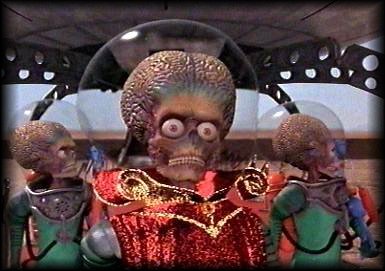
In Mars Attacks, Tim Burton uses conflict between man and Martian to satirize the military, as well as science fiction as a genre.  One of my favorite jokes was the flip of how most movies portray generals in conflict.  When the aliens first arrive, they obliterate what looks like a thousand people in a number of minutes.  Immediately, the people assume that it was a “cultural misunderstanding” and attempt to make up the issue, while General Decker is suggesting an offensive attack.  Instead, the government decides to let the aliens into their congress!  Obviously that turns into a big snafu and we are left with the president again suggesting that they try to make peace with the Martians.  By this time, General Decker is literally screaming at the president for war and the president scolds him for it.  It’s really funny because normally the warmonger general in a movie is the bad guy, or at least the stupid guy who makes everything go to hell.  In this case, he is the voice of truth.  Instead of satirizing the overzealous general, Burton takes a poke at the government as it tries again and again to make amends with an overtly bloodthirsty race of Martians. 
                It also pokes at the government in another way.  The Martians seem invincible and no one knows how they are going to get rid of them.  The government tries everything from diplomacy to nukes and everything in between to stop the slaughter, but nothing works.  The government tries so much stuff, they neglect something as simple as the “Indian Love Song.”  After the world is nearly annihilated, we find redneck Richie and his senile grandma about to be killed before they accidentally discover that her god-awful music is the only thing that can kill the Martians.  I think that Burton uses this instance to tell his audience not to trust their government as much as they do.  In a big crisis, we also have to have a plan.  This contrasts greatly with Independence Day, when the government is the end all be all to the human race.  

Friday, March 8, 2013

Mroski Ed Wood

Ed Wood pays homage to Edward Wood in a tragically dignified manner.  I loved how the movie itself took place on cheesy looking sets in black and white, just to glorify Ed Wood's "style" of screenwriting.  The movie had a great sense of sketchiness about it; its artistic value is great since it takes so much of Ed's cheap looking style into account.  Also, the book-ending helped set the corny tone that was supposed to be felt in the movie.
Ed Wood was filled with many different shots of the films Edward Wood himself created, replicated very well by the cast of the Burton film.  There were many scenes, from the zombie Vampira scene, to the scene with Bela going on his favorite speech, to the scene in Glenn or Glenda when his wife gives Glenn (or Glenda) the shirt.  All of the these scenes are a great homage to viewers who know his works, as well as a hint that the story is biographical to those who do not know about his movies.  I was shocked at the similarity when I watched the documentary  as well as plan 9, at how similar they were. Those similar little shots drew me in and made me want to actually watch more of his movies to see if I could catch the extra shots that were "stolen" from the movie.
Many of the characters were strikingly similar to the real life people that they represented.  The casting was very well done and in some cases looked frighteningly close to how the real people looked. As with the familiar scenes, the familiar characters draw in non-fans and captivate die hard B movie watchers.
All of these characters were total outsiders.  They were all somehow rejected from the Hollywood world.  This was interesting because Tim Burton tends to also have a little cult of people that feel most accepted with him.  Just as Ed Wood, Tim Burton re-cycles actors and works with the outsider-type people that he feels most comfortable with.  Casting characters who look so similar to their real life counterparts brings Tim Burton's ability to withhold judgement, just like Ed Wood, come to life.

Wednesday, February 27, 2013

Mroski Edward Scissorhands


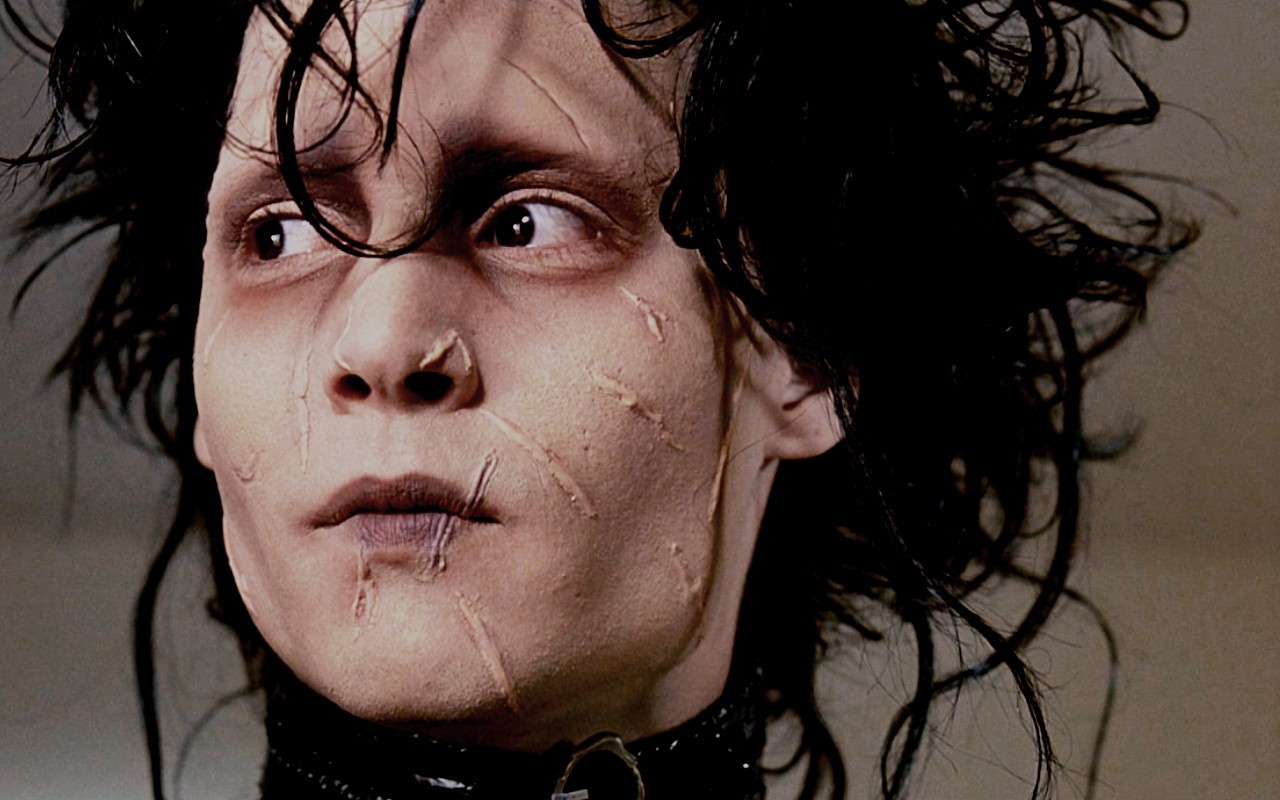
In Edward Scissorhands takes fairy tale elements and turns them inside out.  This one reminds me mostly of the Beauty and the Beast.  Obviously, Kim is alluded to Belle, and Edward is the beast, who lives in a castle.    The story is undermined, though, because it is the beast who comes down from the castle.  Belle's selfish sisters are very similar to Kim's friends, who keep trying to get things out of her and Edward, like when they rob the house to get money for a van.  In the Beauty and the Beast, there really isn't any violence at all.  Edward's violence arises out of misunderstanding, and seems to be there mostly for plot development rather than the establishment of a moral.
I have a sort of negative view about how people work.  I don't think we have very much true morality at all, because if society had a full sense of morality, we wouldn't need laws in the first place.  In America, it is generally believed that morality comes from the self.  I believe that it comes from outside of us. If truth is really inside us all, then why do we keep fighting over what's right? Right is right and wrong is wrong.  
That said, the people of the suburbia that Edward lives in try to look like they have it together, but they don't. The blog prompt describes the town as looking “squeaky clean” but to me, it looks suspicious.  Nothing that well-kept has a clear conscience.   I think that their biggest downfall is the gossip that the women take part in.  Small lies in the movie quickly turn into huge stories, like when Edward refused to have sex with Joyce only to have the grapevine turn him into a rapist overnight.  The people of the town accept what they hear about other people as fact before they can find out if it is valid, and then judge the person accordingly. The gossip creates a sort of loop, because in order to look good in such a messed up society, you have to have someone that looks worse than you.  The suburb is lost in itself, playing the blame-game in order to stay on top of everyone else.

Friday, February 22, 2013

Mroski "Robot Boy"


“Robot Boy” has an interesting archetype.  Jungian archetypes can be situations as well as people, and one in this poem  is parental alienation.  Since so many of us feel that gap between us and our parents, we are all able to relate to this event in the same collectively unconscious way as the character archetypes that we learned about in class. 
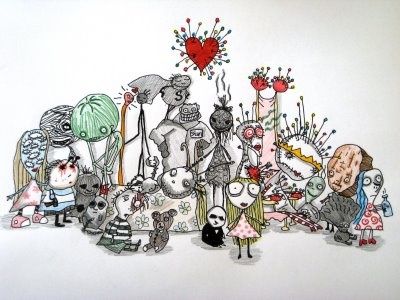
                Tim Burton’s life is a life of alienation and outsiderness that is highlighted in his movies, as well as the poems in the Meloncholy Death.  In his personal life, he experienced this alienation most notably with his parents, a reoccurring theme that is seen in almost all of his works.   One reason he wasn’t close to his parents was probably that he wasn’t the way his parents expected him to be.  Sound familiar?
Robot Boy is certainly an alienated little cyborg.  His parents don’t love him because isn’t a cute little human baby.  If that isn’t bad enough, they find out that their Robot was born outside of their marriage.  Knowing a person’s  child is not actually theirs can make an even bigger gap. Even though the story is mostly about the parents, we can tell that he is shunned for his whole life by the strange since of irrelevance in the last stanza of the poem (and robot boy grew to be a young man. . .). 
                The parental alienation archetype, like all other archetypes that we have studied, is based on this collective unconsciousness that we all share.  These archetypes help us to make since of the world because they give us all something that we can equally understand.  So, Tim Burton uses Robot Boy in this common situation, used in so many of his works, as a way to express and at the same time cope with these childhood experiences. 
                Another theme (which isn’t so much of a generic situation) that Burton uses in these poems is this flip of what people expect when they have a child.  When someone has a child, they are usually at least very happy about it.  In the book, every time someone has a kid, this situation is flipped.  Children destroy their parents’ lives in this book, when the expectation in the beginning is a grounded and enhanced life. I wonder if Burton has this feeling that he messed up his parents’ life.

Friday, February 1, 2013

Mroski Batman/Catwoman


  Batman and Catwoman’s  relationship, since they have dual identities, is a dual relationship.  As Bruce Wayne and Selina Kyle, they are reasonably tame.  This calm relationship is opposed with Batman and Catwoman’s more hostile if not animalistic relationship.  Their love interest, however, is destined to fail.
                Selina Kyle and Bruce Wayne display relatively normal courtship, unlike Batman and Catwoman.  Bruce and Selina meet, think each other are cute, go on dates, and carry a very average romantic interest.  Their relationship seems to have a bit of repression.  In most movies, the man and the woman’s sexual interest is very overt, but it doesn’t seem like that here.  They don’t even kiss throughout the entire movie.  Their conversations are very surface level, except for when they are at his house, talking about his “conflicting truths”
                Batman and Catwoman have a more sexual and violent side.  Catwoman is deceptive,  playing tricks on Batman by using the fact that she is a woman to seduce then destroy him.  In their first fight scene, there is a slight confusion as to whether she is trying to hit on him or kill him.  When he punches her in the face she falls over, yelling “How could you, I’m a woman,” before she takes control of the fight, completing her sentence “a woman who shouldn’t be taken advantage of.”
                Catwoman and Batman’s relationship are set to fail for two main reasons: their differing morality and their reclusiveness.  Catwoman, like a cat, does whatever she wants, whenever she wants, from attacking random criminals in the streets, to completely blowing up a building. Her actions are what benefit her the most at the time, regardless of its effect on others.  She doesn't even have a side to take when it comes to taking down Max Shreck. She works with Penguin for a while, but in the end deserts him.
Batman, on the other hand, is a Dark Knight.  Even though we discussed in class that his motives are ultimately for himself, in order to really feel right about it, he still has to be the good guy.  He fights against evil.  Even if the fact that he is a hero is up to debate, he still thinks of himself as a hero, and heroes don’t work well with chaotic characters like Catowman.  Catwoman wanted to kill Shreck, and Batman wanted to jail him.  In the end, their conflicting tendencies and ideas of justice contradict their relationship.
As we discussed in class, they also shun the opposite sex.  Batman, with the death of his parents, is naturally a very reclusive character who unconsciously wants to be alone.  To have a steady woman forever in his life is against batman’s character.  As for Catwoman, she just doesn't like men.  She was killed by a man.  She was almost raped by a man. Their similar subconscious, reclusive dislike for company of the opposite sex also inhibits their relationship.


Friday, January 25, 2013

Mroski Joker


                Dauntless Media
               The Joker’s very demeanor would instantly be alluring to someone like Tim Burton.  Burton loves to hybridize ideas that seem juxtaposed, and that is essentially the way that the Joker is presented.  He has an incredible ability to be both chilling and hilarious in a sense of twisted balance that Tim Burton captured very accurately in the film. The trickster is an enduring character archetype and the Joker is a great example, though he is not a perfect match.  Much like many other trickster characters, he is rebellious, curious, rambunctious, and deceitful.  The complete opposite of Batman, his only goal is to create chaos, challenging societal norms and social custom. 
                The most obvious trickster quality the Joker possesses is deceit.  Tricksters typically like to use a quality that another person has in order to create some form of chaos, as if using the person’s momentum against them.  A scary and violent way that he does this (probably the most mentioned scene in the movie) is when he announces that he will be showering the people of Gotham with money in a parade, only to Gas the entirety of the crowd with poison.  One way that this plays against the trickster archetype is that he has no true motive for doing so other than that he simply has the desire.  Classic tricksters tend to have a motive, whether it be that they want to eat someone, steal their child, be married, or simply get paid.  The Joker enjoys evil for its own sake.
                Another form of deceit that takes on a different role is the face paint.  The Joker, like many tricksters, is a shape shifter.  Even though he cannot physically change his appearance, he chooses sometimes to wear face paint, and sometimes to take it off.  In situations where he wants to be on the peoples’ side, he goes without the mask.  This is a way that he can lure people to his evil plans.  On the other side, his clown costume is there to separate and elevate him.  He is different with the mask, scarier, and often more violent.
                Tricksters disregard social protocol and authority.  The Joker questions the way that society works by ignoring social boundaries and formalities. He reacts inappropriately to most situations against what most people would expect.  The Joker says whatever he wants and does whatever he wants, just like when he sabotages the fine art in the museum.  His reckless vandalism is an overt strike at Gotham’s government and police force because there is no practical reason to do so.  Tricksters tend to react differently to stressful situations.   The Joker’s responses to hostile circumstances are usually the opposite of what someone would expect.  Every time he kills someone, and he kills many people throughout the movie, he is in a frenzy of laughter, at one point even talking with a person’s burnt carcass.

Friday, January 18, 2013

Mroski Beetlejuice


Beetlejuice
Death Denial
Beetlejuice denies death by making death seem like life.  The dead have to have jobs, sit in waiting rooms, and deal with pests in their homes just like the rest of us.  This denies death by making it seem more like a transition than an actual death.
We see denial even in the way that death is first presented.  The Maitlands are unaware of the fact that they have even died in the first place.  Even when they realize that they are dead, they just try to keep “living” their day to day lives until they are presented with the problem of people destroying their house, which they are still attached to like living people.
Death is also overlooked in the way that Lydia is able to converse and live with the Maitlands almost as if she were their own child. After all of the bio-exorcism hooblah is over with, we find Lydia talking about her school work, dancing, studying, and visiting with the ghosts as if it were normal.  This makes them seem more like living people and less like ghosts.
Personally, I look forward to when I die. Not to say that I want to die, but I embrace the idea of death and the possibility of something greater.  That said I come from a Christian standpoint, and thus I do believe in an afterlife.  I feel like America is more predominantly a deistic country than anything.  Most people believe in a being, and that he just started the universe and left it alone, like a divine clockmaker, or don’t believe in God at all.
            The reason I bring all of this religious crap into the post is to suggest that most people in America don’t whole-heartedly believe in anything after death. As the saying goes, “the heart can’t exalt what the mind rejects.”  If there isn’t anything after we die, what’s the point if you are just going to die eventually? In the long run will it really matter if I contract cancer and die at 40, or if I get mauled by a lion ten minutes from now? From a standpoint that doesn’t truly believe in an afterlife, you die, and that’s it.  It’s the end. Sometimes the best way to deal with a truth that uncontrollable and that dark is to hide it from sight, and that is exactly what happens in America.
            In other countries where death is more embraced, the people usually think that there is something more after you die.  In these cultures, death is a part of the cycle of life. There is a belief that there is something more to death than an ending.  It is a lot easier to work with and talk about this idea than to say that we are all completely pointless blips in a fragment of an eternal existence. 

Tuesday, January 8, 2013

Mroski Introduction


     My name is Taylor Mroski, from the reasonably close city of Covington, Louisiana.  I'm 19 years old. I've been playing music since the fourth grade.  At Loyola, I am a jazz bassist, studying music education. (subject to change). I play Euphonium in the wind ensemble here.  I am also a singer/songwriter and guitarist, and since I have arrived here I have recently formed a band of my own. So far it is still nameless.  I am very active in my church.  I play bass in the band there, as well as help lead small group bible studies for the youth.
     It feels notable to mention that I am pretty shy in the classroom, but I speak a bit louder on paper.  I take time to consider things rather than just blurt in the classroom, mostly because I really try to make whatever I say match exactly how I feel.  One of the most important things to me is staying true to myself so that when a person sees me, there is nothing hidden.  I think that's part  of the reason that I can honestly say that I am truly a happy person.
      I am pretty scatter-brained, which, aside from causing me to forget what I am saying mid-sentence, leads me to take up various interests in random activities like camping, longboarding, writing poetry and short stories, and playing various other instruments including but not limited to the didgeridoo.  That said due to my short attention span I am completely horrible at all of these things. To me it isn't about how good you get at a hobby so much as how much you enjoy it. After all, these kinds of tasks are for fun, and for me, new things are fun.
      Tim Burton class is new, so I already enjoy it. I've always had fun in English class, which makes me think I will love being with this group of people. It seems like this class will be taught in a similar way.  I love being in college because now we aren't shunning using social media to teach.  Blogs seem like a seriously fun way to learn about the beautifully twisted world that Tim Burton has given us all to explore.  Hopefully this method of learning is as communal as I have made it out to be.  After all, we all have one similar trait in this class, which is at the very least an interest in Tim Burton's unique style of film.